In 1987, Kenneth Parks, a 23-year-old Canadian, drove 15 miles to the home of his mother and father-in-law. Upon arrival, he stabbed both with a kitchen knife, killing his mother-in-law and severely injuring his father-in-law. With an immediate confession from Parks, this seems like an easy case. The problem? Kenneth Parks was sleepwalking at the time of the crime.
Parks claimed he did not remember any of his actions and that there was no reasonable motive for the murder. This leaves the court to determine whether sleepwalking constitutes non-insane automatism. Automatism is the performance of actions without conscious thought or intention. In Canada, automatism works as a defense and results in absolute acquittal. Once the defendant raises automatism as a defense, the burden is on the court to show that the acts were voluntary. R v. Parks, 2 S.C.R. 871 (1992).
As in Canada, automatism is a defense in the United States. Automatism in the U.S. is more commonly referred to as the Unconsciousness Defense that occurs when the defendant was unconscious while the offense occurred.It is a complete defense to all crimes, including the strict liability offenses. State v. Hinkle, 200 W.Va. 280, 489 S.E.2d 257 (1996). There are two exceptions: felony murder and “when the crime charged can be committed recklessly or negligently and the defendant, knowing of his tendency to black out, put himself in a position where a manifestation of this tendency would be especially dangerous”. N.C.P.I. - Crim. 302.10 n. 1.
Non-insane automatism is where the automatism is caused by external factors, is not continual and is not linked to any disease of the mind. Id. Parks did not have any mental conditions and had no past experiences with sleepwalking. He had, however, been working long hours and getting little to no sleep. Ultimately, Parks was acquitted both at trial and on appeal.
Should unconsciousness negate the crime committed?
Do you believe there should have been consequences for Kenneth Parks?
A handful of companies have pushed the boundaries of intellectual property law by laying claim to individual colors.
On a summer day in 2019, Daniel Schreiber opened his mailbox to find a threatening letter from one of the world’s largest telecom companies.
In the letter, Deutsche Telekom AG (the parent company of T-Mobile) accused Schreiber’s small insurance startup, Lemonade, of trademark infringement. Schreiber was confused: He hadn’t used T-Mobile’s name. He hadn’t appropriated the company’s logo or tagline. Hell, he wasn’t even in the cell phone business.
But as he read on, he realized his “crime” was using the colormagenta.
In recent years, companies like T-Mobile have achieved something once thought to be legally impossible: They’ve successfully trademarked individual colors.
When a color becomes synonymous with a brand — thinkrobin egg bluejewelry boxes,browndelivery trucks, ororangescissors — a company can claim a certain form of “ownership” over it.
But how is it possible for a single corporation to call dibs on a color? And what effect does this exclusivity have on its competitors?
A colorful history
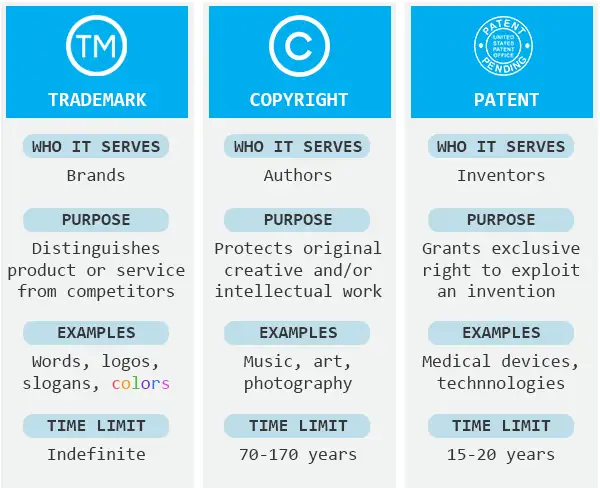
Under the umbrella of intellectual property law, the 3 most common applications are the trademark, the copyright, and the patent.
While corporations routinely file all of these, they use the trademark to (quite liberally) protect anything integral to their brand. Underlegal doctrine, this might be “any word, name, symbol, or device [used to] identify and distinguish” a company’s good or service from its competitors.
When a trademark is granted, it gives a company the exclusive right to use that intellectual property in its respective industries.
Note: Though trademarks are indefinite, they still need to be renewed every 10 years. (Zachary Crockett / The Hustle)
For many years, a color did not, by itself, qualify as a trademark.
Though companies had successfully trademarked combinations of colors (e.g., Campbell’s soup labels), the US Patent and Trademark Office shot down attempts to trademark a single color. John Deere, for example, would not be permitted to lay claim to the colorgreenin the farm equipment industry.
Scholars maintained several arguments against issuing single color trademarks:
Color depletion theory: Only around1,867solid Pantone colors exist; if brands all claim a color, we’ll eventually run out.
Shade confusion theory:It would be hard for the consumer to determine the difference between slight shade variations of colors claimed by brands.
But everything changed when this stuff came along:
Owens-Corning fiberglass insulation in its trademark pink-dyed hue (Pixabay)
That, dear readers, is a piece of fiberglass insulation (the stuff that goes behind our walls) from a company called Owens-Corning.
In the late1950s, Owens-Corning was facing steep competition from other fiberglass insulation companies. At the time, all products were the same “naturallytan” hue; to distinguish itself, Owens-Corning decided to infuse their product with dye.
For the next 30 years, the company used its uniquepinkinsulation as a marketing tool: It adopted the slogan “think pink,” used the Pink Panther as a mascot, and spenttens of millions of dollarsadvertising the color.
In1985, after a 5-year legal battle, Owens-Corning became the first company in American history to successfully trademark a color.
Ten years later, a second company, Qualitex, went all the way to theSupreme Courtto defend its right to trademark its signaturegreen-golddry cleaning pads. The court ruled that color could, indeed, serve toidentifya brand — and in doing so, opened up the floodgates for companies to file their own color trademarks.
What does it take to trademark a color?
In the decades since that Supreme Court case, a number of companies have successfully trademarked single colors.
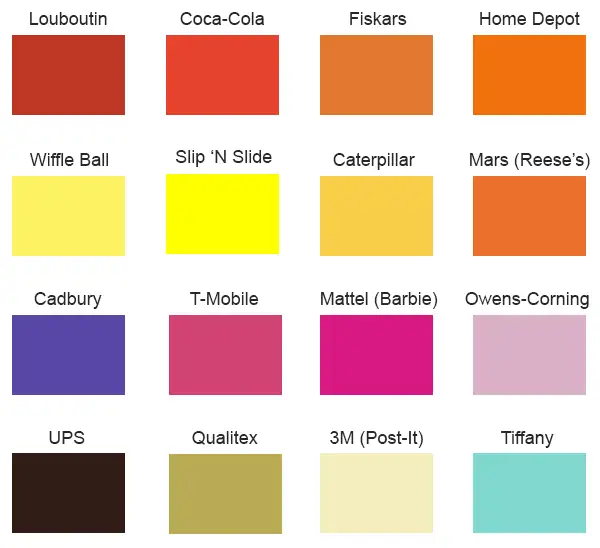
Tiffany & Co. trademarked its famousbluein 1998 — the same year UPS trademarked its “Pullman Brown.” 3M secured its signaturecanary yellowcolor for its Post-it notes, Deutsche Telekom AG protected T-Mobile’s famousmagenta, and Fiskars has one fororangescissor handles.
There are even a few you wouldn’t expect: The Wiffle Ball, Inc. has a trademark onyellowfor use in bats, and the estate of the late musician Prince currently has onependingfor the colorpurple.
These trademarks aren’t exclusive to businesses, either. The University of Texas at Austin (Pantone 159) and The University of North Carolina at Chapel Hill (Pantone 542) both have protections on their school colors.
A few of these companies, like Cadbury, have since lost their color trademark in legal disputes (Zachary Crockett / The Hustle)
Plenty of brands trademark certain colors that might appear in conjunction with a logo (think, for instance, McDonald’sredandyellow, or Facebook’sblue). But these companies have done something different and far rarer: They have trademarked literal swatches of color.
“Usually a company does this when its business model relies, to some extent, on a particular color,” says Jeffrey Samuels, a professor emeritus at The University of Akron School of Law. “It will trademark a color to prevent other companies from using it.”
An important distinction, adds Samuels, is that a company with a color trademark only “owns” the color in connection to particular goods or services.
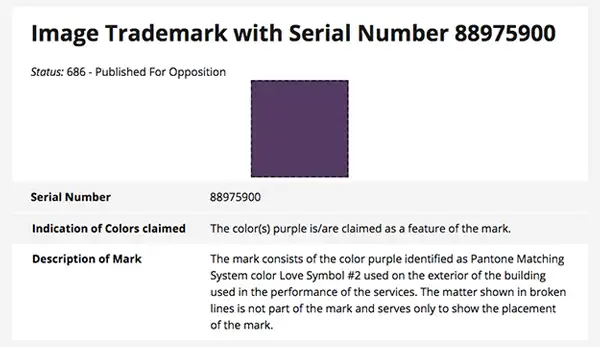
Take, for instance, the purple trademark from Prince’s estate, Paisley Park Enterprises. The trademarked image is the color purple alone — no words, no logos, no other form of branding. If granted, it will give them a claim to the colorpurplefor use in live music venues. Purple alone, they claim, is enough to ID their brand.
A trademark filed by Paisley Park Enterprises seeks to secure a shade of purple (Pantone color “Love Symbol #2”) for use in musical performance (Justia)
To successfully secure such a trademark, a firm mustprovethat a single color:
Achieves “secondary meaning” (distinguishes a product from competitors and identifies the company as the definitive source of the product)
Doesn’t put competitors at a disadvantage by affecting cost or quality
Doesn’t serve a functionalpurpose
This last piece, says IP lawyer Robert Zelnick, means that “a color really has to be quite arbitrary” to be trademarked: It can’t be essential to the production of the product or serve any utilitarian purpose.
Sometimes, proving all of his can be extremely challenging.
General Mills, for instance, hastwice failedto secure atrademarkonyellowfor its Cheerios box, on the grounds that the color isn’t synonymous with the brand since too many other cereal companies use it in their branding.
Pepto-Bismol’s attempts totrademarkpinkwere thwarted when a court deemed that the “therapeutic” effect the color had on customers was “functional.”
The color wars
As the CEO of Lemonade learned, companies thataregranted color trademarks often go to great lengths to enforce them in court — and competitors often challenge their right to monopolize certain hues.
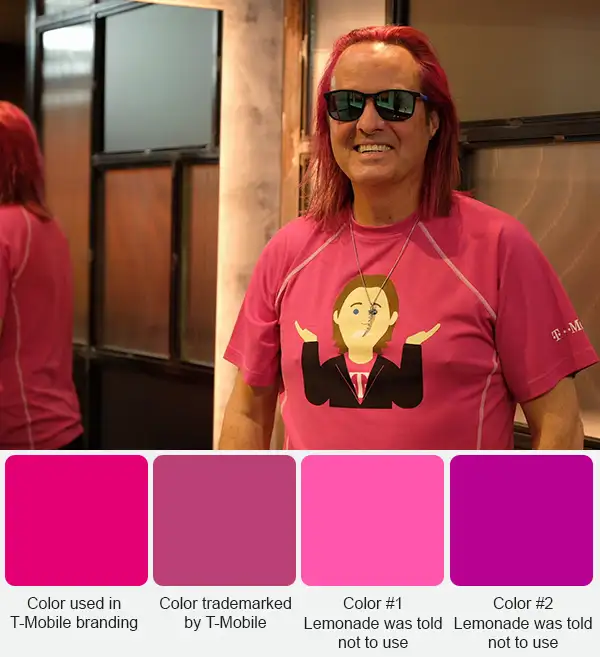
TOP: T-Mobile’s ex-CEO John Legere went above and beyond to embrace the brand’s magenta hue (Twitter); BOTTOM: A diagram of colors from the T-Mobile/Lemonade incident shows the variance in colors that brands claim to “own”
Over the years, these controversial trademarks have resulted in dozens of lawsuits relating to color “ownership:”
In 2002,Mattelbrought suit against MCA Records for, among other things, allowing the band Aqua to use its trademarkedpinkcolor on its album cover for the single, “Barbie Girl.” The judge famously advised both parties to “chill.”
In 2010,Hersheysued Mars for usingorangeon the packaging of a peanut butter candy bar. The suit was later dropped.
In 2011,Louboutinaccused Yves Saint Laurent of infringing on its trademarkredshoe soles and won.
In 2015, toolmakerDeWaltwon a $54m judgment against a competitor that copied itsblackandyellowcolors, though it was later tossed out on appeal.
But one company has beenparticularlyprotective of its color trademark.
T-Mobile’s parent company, Deutsche Telekom AG, has spent at least 12 years attempting to prevent competitors — some large, some small — from usingmagenta.
Though its trademark covers only a specific variation of the color (Pantone Rhodamine Red U), the company has expanded its definition of magenta to encompass a variety of surrounding hues. Since Deutsche Telekom has its hands in so many projects, it has also been able to defend its trademark in industries outside of telecommunications,rangingfrom fashion to healthcare.
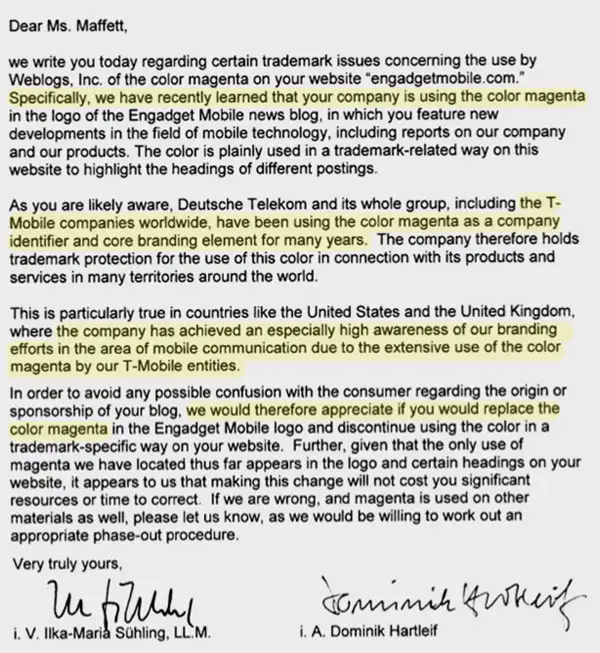
In 2008, it went after the rival European wireless carrierTelia. A few months later, it demanded that the tech blogEngadgetdrop magenta from its mobile logo. In 2014, a judgeruledthat AT&T subsidiary Aio Wireless couldn’t usemagentabecause it would confuse T-Mobile customers.
A letter sent by T-Mobile’s parent company to Engadget, demanding that the blog stop using the color magenta in its logo (Engadget)
Its latest victim, Lemonade, has complied with T-Mobile’s demand by changing the color of its marketing materials in Germany, where Deutsche Telekom AG is based. The company has alsofileda motion in Europe to “invalidate Deutsche Telekom’smagentatrademark.”
Making changes like this can be costly — especially for bigger firms that spend tens of millions of dollars on marketing and branding strategies.
But legal fees can also rack up for the companies that constantly trawl for color trademark violations, begging a question:
Is trademarking a color worth all the effort?
When a company files a trademark in black and white — say a simple logo — the trademark is actually protected inallcolor variations by default. Nobody can, say, take the McDonald’sredandyellowlogo, make itpurpleandgreen, and claim it as his own.
So, why would a brand go through all the trouble of trademarking a color when they likely already have so many other protections?
“You only see brands do this when the color is critical to the brand, or sales, or the way the product is marketed,” says Zelnick, the IP lawyer.
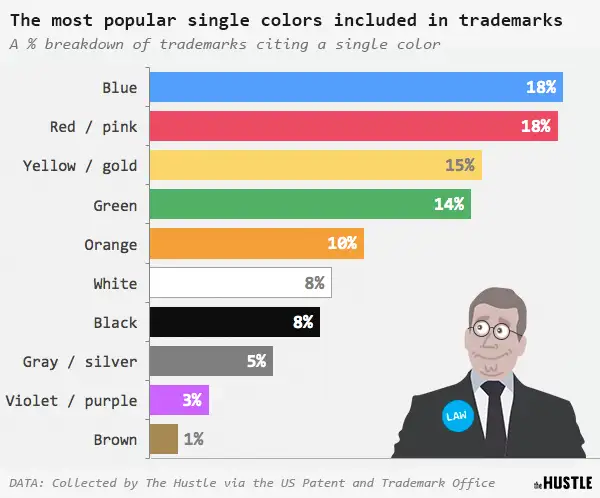
Across all trademarks (including logos), blue is the color of choice (Zachary Crockett / The Hustle)
Most marketers are aware of the effect color has on consumer behavior. Surveys and studies have shown that:
62%-90%of a consumer’s initial judgment of a product is based on color.
52%of consumers say the color of packaging is an indicator of quality.
Welcome back and welcome new students! After a very hot summer, you can now cool down in the AC (while also learning the law 😉).
If you are new, this blog is a place to discuss legal trends, events, and advice for law students. My name is Taylor Mace - a 3L - and I am your Editor in Chief. Any students or professors that would like to write for the blog can contact me via e-mail at taylor.mace@msl.edu.
I would like to give a big welcome to all the 1L students starting this week. Law school may seem daunting in the beginning, but there are so many fun and rewarding days ahead of you! Professors and students, alike, are available to help you with all questions.
Here are some important resources as you start your law school journey:
SBA President - Bradley Nestor bradley.nestor@msl.edu
IT/TWEN Questions (and a WEALTH of other knowledge) -
Dan Harayda harayda@mslaw.edu | Mick Coyne mick@mslaw.edu
Tips from a 3L:
It's never too early to start asking questions. Ask the writing lab, advisor, or senior students to review your case briefs. Figure out how to use TWEN and Examsoft. These will be crucial for all of your classes.
Meet with your advisor to plan out your 3 (or 4) years. This may change, but it is good to see how you will plan out your 90 credits.
Take summer courses (especially UCC courses).
Commercial study materials are great, but use them to supplement your own outlines and case briefs.
Participate in class and answer as many of the professor's questions as you can. If you are right, great! If you are wrong, you will never forget the right answer.
Whether you are going on vacation, studying for the bar, or taking a class, I hope everyone at MSL has a great summer break!
This will be the last blog post of the school year, but I will return in the Fall. If you would like to write for the blog or have suggestions for future posts, please comment below or e-mail taylor.mace@msl.edu.
In 2017, the Supreme Court held that a law prohibiting trademarks that disparage any person living or dead was unconstitutional because it offended the First Amendment principle that speech may not be banned on the ground that it expresses ideas that offend. Matal v. Tam, 137 S. Ct. 1744 (2017).
Simon Tam, the lead singer of a band, chose a band name that had the purpose of reclaiming a derogatory term used against people of Asian descent. Id. When Tam wanted federal registration of the band name, the Patent and Trademark Office denied the application under the Lanham Act. 15 U.S.C. §1051 (1946). For reference, trademarks are identifying marks that people can easily identify as belonging to a product or service. The office claimed the Act prohibited the registration of trademarks that may “disparage or bring into contempt or disrepute any persons, living or dead.” Id.
The main issue in this case was whether the disparagement clause was facially unconstitutional under the First Amendment’s Free Speech Clause. The court held that it was. Their reasoning was that trademarks are private speech, not government. The court further explained that the Act violated the Free Speech Clause of the First Amendment because it violated the principle that speech may not be banned on the ground that it expresses ideas that offend.
Do you think this reasoning is too broad or do you agree with the Supreme Court decision?
Law students are notoriously hard workers. We feel as though we are wasting valuable time if we aren’t outlining, case-briefing, or going over past exams. This is especially true as final exams are approaching. The truth is, though, research shows that taking breaks from studying to refresh your brain and body can increase energy, productivity, and the ability to focus (health.cornell.edu). It can even improve your memory (Id). Students should find activities to give their mind a break and allow your body to zone out. HINT: Social media scrolling doesn’t count! Your breaks should be purposeful and not merely distractions.
Here are some ideas for purposeful study breaks:
Go for a walk or hike: Check out AllTrails for paths and hike information near school or your home.
Meditate: There are plenty of guided meditation resources available on YouTube, as well as free meditation apps.
Take a 20-minute nap: Name one law student who doesn’t need more sleep!
Take a shower: Warm water can ease tensed muscles and rejuvenate your energy.
Stretch: This can be yoga or just standing up to touch your toes.
Call a friend or family member: Just remember not to talk about school!
Cook or Bake: This is a guaranteed distraction because you have to follow a recipe to get the dish just right. No thinking about Property during this one!
Creative Crafts: Draw, paint, scrapbook, or even start making lanyard bracelets like you used to in middle school (yes, I started doing this last semester!)
These odd laws are still in effect in Massachusetts. Have you broken any lately?
It is illegal to give beer to hospital patients. M.G.L. c. 270 §5.
Hunting on Sundays is prohibited. M.G.L. c. 131 §57.
Spitting on a public sidewalk shall be punished by a fine. M.G.L. c. 270 §14.
It is illegal to frighten a pigeon. M.G.L. c. 266 §132.
Defacing a milk carton is punishable by a fine. M.G.L. c. 266 §128.
If you are over 16 years old, you can be fined for yelling any profane or obscene language at an official or participant in a sporting event! M.G.L. c. 272 §36A.
It is a punishable offense to willfully disturb people in a public library. M.G.L. c. 272 §41.
It is illegal to sell fewer than 24 ducklings at a time before May 1. M.G.L. c. 272 §80D.
Reproaching Jesus Christ or the Holy Ghost can land you in jail. M.G.L. c. 272 §36.
Targets at shooting ranges cannot resemble a human being. M.G.L. c. 140 §131.
These silly laws haven’t gone unnoticed. “An Act Relative to Archaic Laws”, a Bill Senator William N. Brownsberger has brought to present before the senate, will get rid of laws number 3, 4, 6, and 9 if passed. 2021 MA S.B. 930 (NS). There are 23 other proposed archaic laws in this bill, though none as funny as these! Head to Westlaw to read the full Bill.
If you’ve been paying attention to the news, you know that a new Supreme Court Nominee, Ketanji Brown Jackson has been nominated by President Biden. Ketanji Brown Jackson has experience with Supreme Court Clerking, as a Public Defender, as a District Judge, and as a Court of Appeals Judge. But what does it take to be selected as a Supreme Court Justice?
As with any job, there are qualifications. While the Constitution does not provide specifics such as age, education, or citizenship, it does require that all Justices are trained in the law - but not necessarily law school! For example, James F. Byrnes, who served as Justice from 1941-1942, did not attend any law school (www.supremecourt.gov). He did not even graduate from high school. However, he did teach himself the law and passed the bar. Wouldn’t that be nice? Of course, standards and schooling has changed since the 40’s and Justice Byrnes was the last Justice to be appointed without a formal legal education.
If you have set your sights on becoming a Supreme Court Justice, you’ve done yourself a great service by attending law school. Next, you must be selected. The first step is to be nominated by the President to fill a vacancy on the Court. From here, the Senate votes to confirm the nominee, which requires a majority (Id). Should the nominee be confirmed, the Constitution states that Justices “shall hold their Offices during good Behavior”. U.S. Const. Art II, §2. This means Justices hold office as long as they choose and can only be removed from office by impeachment.
Do you think there should be stricter parameters in qualifying for a Supreme Court Justice position? Should there be term limits to ensure the Court is representative of the society in which they serve?
-Taylor Mace
Supreme Court of the United States. “General Information.” Home - Supreme Court of the United States, https://www.supremecourt.gov/about/faq_general.aspx.
It seems like recently every show or movie is the dramatized retelling of someone’s life story. There’s “Inventing Anna”, “Pam and Tommy”, “The Dropout”, “The Girl from Plainville”, and many more. But what does it mean when someone’s life story is purchased for these shows? When the rights to portray someone in film or television are purchased, it is actually a bundle of rights, including protection from suits based on defamation, invasion of privacy, and the right to publicity (Litwak, 2016). The purchaser might even need the subject’s participation or the participation of the family to have access to personal items. The parties must decide the scope of the rights provided (Id). Will the purchaser have rights to remakes, sequels, or merchandise? Will the subject’s partner, children, or friends be depicted? The buyer will want to ensure the agreement is as comprehensive as possible to allow for the greatest artistic control over their work. With so many of these life stories based on criminal conduct, like the local story of Michelle Carter in “The Girl from Plainville”, an important aspect to consider is the Son of Sam Laws. These laws were named after serial killer David Berkowitz in 1977 in New York after he sold his exclusive story rights (Thomas, 2009). The purpose of the law was to prohibit criminals from profiting from writings or shows about their crimes. However, in Simon & Schuster v. Crime Victims Board decided in 1991, the Supreme Court ruled the statute an unconstitutional content-based restriction (Id). Each state has their own version of the Son of Sam Laws that survive constitutional scrutiny in order to limit criminals from profiting off of the harm and trauma they’ve caused to victims.
Massachusetts attempted to implement their own version of this statute that diverted profits criminals made from their crimes to an escrow account reserved for the victims (2002). The court ruled this, too, would restrict free speech rights. While Massachusetts has repealed the Son of Sam Law, the state has not replaced it. What does that mean for Michelle Carter? Judge Moniz, the judge presiding over her case, ordered that she is not to profit from the publicity of her case for the next two years. Commonwealth v. Carter, 2019. This may have been a factor in the original contract between the producers of the show and Michelle. What do you think is the best balance between the rights of a victim and those of their perpetrator?
-Taylor Mace
Litwak, Mark. Dealmaking in the Film and Television Industry: From Negotiations to Final Contracts. 4th ed., Silman-James Press, 2016.
Thomas, Sandra. Son of Sam Laws, The First Amendment Encyclopedia, 2009,
Is there a connection between law and
poetry? The anthology “Law and Poetry: Promises from the Preamble” suggests
there is. The study of law and the study of poetry is essentially the study of
language. Both disciplines communicate their meanings through carefully chosen
words and both are creations of imagination that add form and structure to the
realities of daily life (Eberle & Grossfeld, 2006). Poetry, like the law,
reflects and can reshape the culture which surrounds it, while offering insight
and understanding into the human experience (Id). We must understand
each other before installing guidelines on how a society may thrive under a
judicial system. Poetry allows the reader to step into the shoes of a judge, an
attorney, a witness, or the accused.
This anthology includes 56 poems – one
for each state, the District of Columbia, and five U.S. territories. In this
collection of poems, the authors challenge the language of the Preamble,
forcing the reader to consider how the shared human experience of opportunity
under the law can be achieved.
Offerings to an Ulcerated God
“Mrs. Lopez refuses to pay rent,
and we want her out,”
the landlord’s lawyer
said,
tugging at his law school
ring.
The judge called for an
interpreter,
but all the interpreters
were gone,
trafficking in Spanish
at the criminal session
on the second floor.
A volunteer stood up in the gallery.
Mrs. Lopez showed the
interpreter
a poker hand of snapshots,
the rat curled in a glue
trap
next to the refrigerator,
the water frozen in the
toilet,
a door without a doorknob.
(No rent for this. I know
the law
and I want to speak,
she whispered to the
interpreter).
“Tell her she has to pay
and she has ten days to
get out,”
the judge commanded, rose
so the rest of the
courtroom rose,
and left the bench.
Suddenly
the courtroom clattered
with the end of business:
the clerk of the court
gathered her files
and the bailiff went to
lunch.
Mrs. Lopez stood before
the bench,
still holding up her fan
of snapshots
like an offering this
ulcerated god
refused to taste,
while the interpreter
felt the burning
bubble in his throat
as he slowly turned to
face her.
-Martin Espada
Letters of Credit
He looks deeply into the mirror of his
children
but cannot see himself,
though he knows he is there,
somewhere in the depths.
They speak to him
with the greatest
politeness, and if there is affection
he feels it as the
slightest warm breeze in summer,
a hot dying breath of
presence, not of comfort.
He works their love like his job,
studying precedent
and applying law to fact,
to derive a holding, a balance
of truth, justice and
equity, completely anomalous
in the calculus of
emotion. Still there is a sense of obligation,
like throwing coins into
the tollbooth - regardless of whether
they hit, or bounce off
the rim and roll away, the debt is paid.
They are gone, glimpsed through
materializing letters
on the instant messaging
boards of computer screens,
or in the electronic
conversions of voices to ear, heard
like the ocean in shell:
false, imitative, distant and faint,
or like letters of credit,
carrying his value into the void
of commerce, of life, to
distant lands he will need see.
-Steven M. Richman
Have you
written poetry about or influenced by the law or your time in law school? Leave
it in the comments or send it to taylor.mace@msl.edu
to be featured on the blog.
-Taylor Mace
Eberle, Edward J. and Grossfeld, Bernhard (2006) “Law and Poetry,”
Roger Williams University Law
Review: Vol. 11: Iss. 2, Article 3.
Adams, Kristen David. Law and Poetry: Promises from
the Preamble. American Bar Association, Business Law Section, 2021.
Writing effectively is an essential part of succeeding in law school and beyond. You want to make sure your words are clear, concise and, most importantly, correct. Below are some terms that are commonly misused or confused in legal papers.
Ensure v. Assure v. Insure – These three words sound similar and are all verbs generally meaning “to make sure”. However, they are not interchangeable. Ensure is something done to guarantee an event or condition. Assure is an act done to a living being to relieve doubt. Insure has to do with limiting financial liability.
Council v. Counsel– You definitely do not want to confuse these when meeting with clients. Counsel refers to advice given to someone, or a lawyer who represents someone in a court of law. Council is a group of people who are chosen to make rules, laws, or decisions.
Affect v. Effect – These two are commonly used improperly. Affect is a verb meaning to influence. Effect is a noun meaning result.
Precedent v. Precedence – You will see the importance of these in your writing and case briefing! Precedent refers to a case that has come before the case in which a lawyer is currently dealing. (The plural is precedents.) Precedence relates to ranking in order of importance or urgency.
Whether v. Whether or Not – If you’ve had Dean Sullivan, you already know there’s a difference. Whether expresses some doubt. On its own, the word implies the “or not”, making it redundant to add it. In addition, leaving the “or not” off, makes it easier to answer a legal issue with a yes or no answer!
Are there other words or phrases you need clarified? Leave them in the comments below.
P.S. There is never a wrong time to reach out for writing help. If you don’t know who to contact, please e-mail me (taylor.mace@msl.edu) and I can connect you to the best person.
Back in 2005, the Supreme Court of the United States decided that it was impermissible under the Eighth and Fourteenth Amendments to execute a juvenile offender under the age of 18 when they committed a capital crime. Roper v. Simmons, 543 U.S. 551 (2005). In 2021, the Washington Supreme Court considered whether the constitutional requirement that prohibits mandatory life without parole sentences for defendants under 18 extends to those defendants aged 18-21. In re Pers. Restraint of Monschke, 197 Wash.2d 305, 482 P.3d 276 (2021). Though the court re-examined the penalty of youthful offenders, sixteen years has allowed science to have a say in the decision.
Neuroscience played a large role in determining the court’s decision. Throughout the majority opinion, concurrence, and dissent, the word “brain” was used nearly 2 dozen times and the words “neuroscience” or “neurological” 13 times. Neuroscientists now know that the differences between juveniles and adults, as recognized in Roper, are present in those over 18. These differences can extend to nearly 20 years of age, leaving the brain undeveloped until this time.
No two offenders are the same, however. Think of your friends or siblings. Each person matured at their own pace, without a reasonable level of predictability. There is a variability in individual attributes of youthfulness that should grant the court discretion as to when these youthful qualities should apply. No meaningful neurological bright line exists between the age of 17 and 20, meaning there is no clear-cut answer. Therefore, courts should have discretion to consider the mitigating qualities of youth into account when sentencing defendants within this age range.
The court held that just as courts must exercise discretion before sentencing a 17 year old to die in prison, so must they exercise the same discretion when sentencing an 18, 19, or 20 year old. The court reasoned that “biological and psychological development continues into the early twenties, well beyond the age of majority”. This conclusion makes mandatory life without parole sentences unconstitutional for offenders younger than 21.
Justice Owens, dissenting, presents an argument that should be given thought, too. She reasons that redrawing the lines of a juvenile based on brain development evidence can leave room for, perhaps, too much discretion. It begs the question of when a person should be held fully accountable as an adult.
Where do you believe the line should be drawn? What else should the courts examine before drawing that line?
In re Pers. Restraint of Monschke, 197 Wash.2d 305, 482 P.3d 276 (2021). Roper v. Simmons, 543 US 551 (2005).
Welcome back to school AND to the Massachusetts School of Law Blog. My name is Taylor Mace, and I am a 3L student who will be taking over the blog as Editor in Chief. This will be a platform where students, staff, and faculty can connect and read about issues related to our legal education. I plan to prepare a new post each week with topics spanning study tips, current events, and comments on new cases or updates in the legal field.
Have something to say? Voice your opinion in the comment section!
Have something to write? E-mail your proposed blog post to taylor.mace@msl.edu and you may be featured on the blog!
I look forward to sharing these posts with you. Have a great semester and talk to you soon!
Here we are in the last week of April! Can you believe it? Next week is May, which means the semester is almost coming to a close! I know, by the end of the semester your energy is drained, you’re ready for summer, and you’re ready for a vacation. Just give these next few weeks your full potential, study hard, and ace those exams. You can do it!
This is actually the last Blog Post of this semester. I cannot believe how fast time flew by. Thank you for reading my posts and for commenting. The reason why I wanted to start this platform is to bring our community together, even during a pandemic, to discuss current cases and stay informed with the cases the courts are presently handling. I have also shared my personal stories and knowledge with you over the past school year whether it be about exam studying tips, how to network, why it’s important to stay motivated, etc. All this just for you! I want you to succeed in this profession, and I know you will. I hope you enjoyed reading my posts. As a fellow 3L student, I know how challenging it can be trying to stay informed on present cases while studying for exams and preparing for class. Just know, it can be done, and I am proud of you for taking the time to read my posts, it shows your motivation for this profession and I love it! This growing platform will be passed on to another motivated student. Stay tuned for the fall semester!
I’ve gotten requests to write more about ways to market oneself and their law firm, so justice will be served only if I do so! Hope the following three more ways help! Like I had mentioned earlier, these are tips I’ve gained over the years and from my personal knowledge. I want to share it with you because I believe we should uplift each other and share our knowledge with those around us while pursuing our own passion. Happy Reading!
Three More Ways to Market Yourself and Your Law Firm
-Website: Almost every law firm today has a website to the point where it’s become the trend that if you don’t have a website, you’re behind. It’s known that a website is a great interactive tool to engage potential clients to your firm, but what exactly should an ideal website have? In my opinion, I think a website should have the following: Attorney Profile Page, Live Chat, Awards, Client Reviews, Cases Won, Practice Areas, Contact Information, and an Inquiry Page. An Attorney Profile Page will allow a potential client to learn more about you and the attorneys in your firm. Include photos, a brief description of the attorney including their educational background, specialty, and hobbies. This will make your website more personable. Including a Live Chat option will give immediate assistance to potential clients and possibly get them in the schedule for a consultation appointment. Immediate assistance is key in an advancing society. Listing the awards your firm has received will advance the status of your firm and be a great seller of your services. It provides assurance to potential clients that they are making the right decision to move forward with you. Client Reviews are essential because they come from clients who were once potential clients just like the people you’re advertising for in the first place. Displaying authentic reviews on your website will give your law firm credibility, trustworthiness, and give your potential clients a glimpse of reality on how it is working with you. Include a Cases Won page as that will give potential clients confidence to contract with you. It’s great leverage for you and your firm to display your wins. Lastly, include your contact information, practice areas, and inquiry page so potential clients can see whether you’re the kind of attorney they’re looking for, how they can contact you, and if you are indeed the kind of attorney they’re looking for, they’ll have a small box where they can write to you about their case and you can take it from there!
-YouTube Channel: This is not much of a common practice…yet. I have come across a few attorney YouTube profiles and I thought hmmm, this is a great idea! Taking a moment to video record yourself speaking about your firm, a recent case you’ve won, or current law is a great marketing strategy prominently because potential clients will be hearing from YOU, seeing YOU, gaining knowledge from YOU, the attorney they are considering to hire. It’s a great way to engage potential clients to you and your firm because it’s raw footage of you speaking the truth about your firm. Watching a video v. reading, I think is more engaging for people, especially those who are visual learners. It’s a fun way to engage the community and get your name out there! Consider it, if you’re not camera shy!
-Billboards: I know billboards are more on the expensive side, ranging from $750 - $14,000/month depending on the location, whether it’s the city or suburbs and the traffic. Once you make enough to afford one, I think you should invest in one because your firm will be on display, over a city, catching many, many, many eyes! Put up a beautiful smiling picture of you, put your number in a vibrant font, and a catchy, kid-friendly slogan, and I don’t think you should be surprised hearing your phone ring throughout the day. If you ask me, I would put money down for one if I have the means. Think about it!
What’s Your Favorite Marketing Strategy?
Thank you once again for your support! Stay Motivated! -Sovmya George
Wow, look at us in the second to last week of April! How are you doing? I want you to take a moment and take in your surroundings, appreciate where you are, how far you’ve come, and appreciate yourself! You have come a long way. You should be so proud of yourself! The semester is almost over, the weather is getting warmer (minus the random snowfall that occurred), and summer is almost here! I hope you have a beautiful week ahead! This week, I have a medical malpractice case I want to share with you. Read on to find out more details on this Plaintiff’s case and his delayed cancer diagnosis.
On April 30, 2009, the Plaintiff, who is a smoker who smoked about one to two packs a day, reported to the emergency department because she had consistent abdominal pain and chest pain. The Plaintiff has a history of costochondritis which is inflammation of the cartilage that connects the rib to the sternum (breastbone). While in the emergency department, a resident and an attending physician ordered a chest X-ray to determine whether the symptoms were signaling pneumonia, infiltrate, pulmonary edema, or congestive heart failure.
Once the X-ray results were ready, they were reviewed by a radiologist who observed a nodular opacity (round shadow) measuring about 7 mm projecting over the left lower chest. The radiologist recommended another a repeat chest X-ray or chest CT to confirm and for further evaluation.
In the meantime, the Plaintiff was dismissed from the Emergency department and was told that the chest X-ray was normal. However, later, the emergency department doctor added an addendum to discharge summary indicating that there was a nodule present on the X-ray but that it was likely just an “X-ray artifact” but should be followed up with a CT or another X-ray. It is disputed whether the doctor ever told the Plaintiff of such findings on the chest X-ray.
Over the next few years, the Plaintiff continued to see her primary care physician for sick visits but the chest X-ray results were never discussed. Along with that, no repeat chest X-rays or chest CT scans were performed on the Plaintiff.
Thereafter, on March 26, 2013, the Plaintiff reported with persistent cough, shortness of breath, and dyspnea (difficult breathing) every time she exhaled. A chest X-ray was performed on the Plaintiff which revealed a 4 cm mass over her left lower chest. At that time, Plaintiff was diagnosed was Stage 4 lung cancer with metastases to the brain, lung, and lymph nodes. The Plaintiff began chemotherapy and radiation therapy in May of 2013.
The Plaintiff claimed the Defendants should have communicated better regarding the need for possible follow-up with a chest CT. The Defendants however contended that there was no specific reason to get a chest CT and that the Plaintiff was aware of the finding and never asked her doctors about any follow-up imaging.
The case settled prior to trial in April of 2020 for $2 million. Around the time of the settlement, the Plaintiff’s lung cancer was stable and she was no longer undergoing any treatment. She continued to work and live independently.
Massachusetts Lawyer’s Weekly Vo. 50, No. 13
Would You Advocate for the Plaintiff or Defendants? Why?